Nota de prensa
Declaración de ESO sobre la aprobación para poner más de un millón de centros de datos en el espacio
26 de Noviembre de 2026
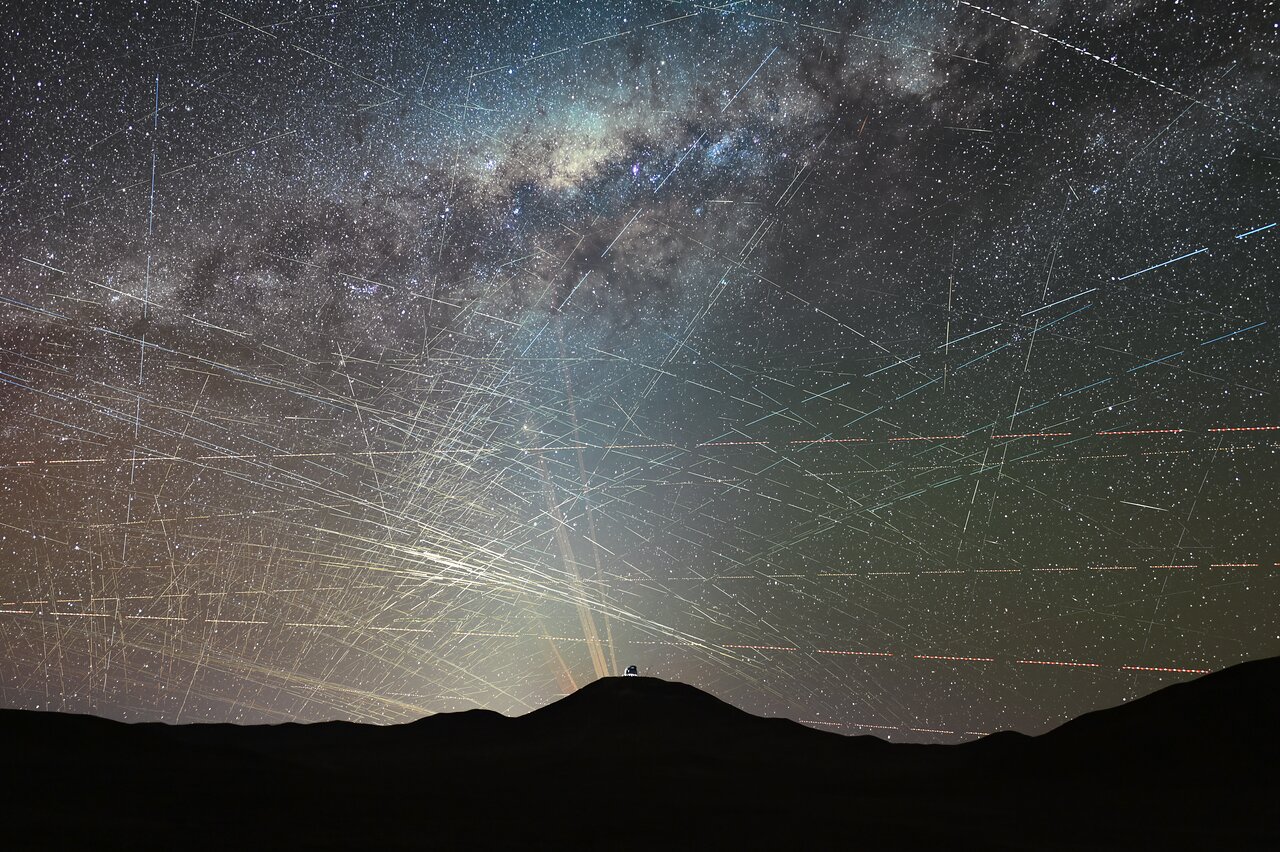
El 25 de noviembre, la Comisión Federal de Comunicaciones (FCC), una agencia federal de Estados Unidos, anunció que había autorizado a SpaceX a desplegar una constelación de un millón de satélites destinados a centros de datos en el espacio.
"Tal como está aprobado este proyecto no solo tendrá profundas consecuencias para la astronomía sino que también va a alterar radicalmente el cielo nocturno para todos los habitantes del planeta. Hemos demostrado estos impactos en un exhaustivo estudio técnico y lo planteamos como respuesta a la FCC de Estados Unidos, al igual que otras organizaciones en todo el mundo. Esta aprobación pone de manifiesto la necesidad urgente de contar con mecanismos internacionales capaces de evaluar actividades cuyos impactos se extienden más allá de las fronteras y afecten el bien común global", señaló Andreas Kaufer, el director general del Observatorio Europeo Austral (ESO).
Un estudio técnico evaluado por pares [1], dirigido por el experto de la ESO Olivier Hainaut y publicado a principios de este año, cuantificó el impacto que tendría el lanzamiento al espacio de grandes constelaciones de satélites brillantes en las observaciones del cielo nocturno. Las constelaciones proyectadas, incluidos los centros de datos de SpaceX, dificultarían la capacidad de la humanidad para observar objetivos cósmicos de baja luminosidad, como galaxias lejanas, algunos planetas similares a la Tierra que orbitan alrededor de otras estrellas e incluso asteroides potencialmente peligrosos para la Tierra.
Si bien las empresas de satélites, incluida SpaceX, están reduciendo el brillo de sus satélites individuales, la gran cantidad de satélites aprobados en estos proyectos implica que el número total de rastros en las imágenes superará lo que se puede mitigar. Más allá de la astronomía óptica, un millón de satélites generaría ruido radioeléctrico, lo que afectaría a la radioastronomía, contaminaría la atmósfera debido a los múltiples lanzamientos y al reingreso de los satélites, y saturaría la órbita terrestre baja, con el riesgo de que se producir colisiones en cadena de gran magnitud.
La ESO respalda los acuerdos internacionales de gobernanza que concilian la innovación espacial con la protección del cielo nocturno, la investigación científica y la sustentabilidad a largo plazo del entorno espacial. A medida que las actividades espaciales se desarrollan rápidamente, las decisiones con repercusiones globales deben respaldarse con pruebas científicas y evaluarse mediante los mecanismos internacionales adecuados.
Notas
[1] A principios de este año, cuando la FCC solicitó comentarios públicos sobre las propuestas de SpaceX y Reflect Orbital, la ESO presentó una respuesta basada en este estudio técnico, en la que se describían las amenazas para la astronomía, en colaboración con la Real Sociedad Astronómica del Reino Unido y con la Unión Astronómica Internacional.
Enlaces
- Declaración de la Sociedad Astronómica Americana (AAS) en inglés: https://aas.org/press/spacex-data-center-fcc-approval
Contactos
Olivier Hainaut (for technical questions on the impacts on observations)
ESO Astronomer
Garching bei München, Germany
Celular: +49 151 2262 0554
Correo electrónico: ohainaut@eso.org
Beatrice Kioko (for legal questions)
ESO Institutional Affairs Officer
Garching bei München, Germany
Celular: +4915155640771
Correo electrónico: beatrice.kioko@eso.org
Bárbara Ferreira (to arrange interviews with ESO’s leadership; general press queries)
ESO Media Manager
Garching bei München, Germany
Teléfono: +49 89 3200 6670
Celular: +49 151 241 664 00
Correo electrónico: press@eso.org
Francisco Rodríguez (Contacto para medios de comunicación en Chile)
Red de Difusión Científica de ESO
y European Southern Observatory
Teléfono: +56-2-463-3151
Correo electrónico: eson-chile@eso.org
Acerca de la nota de prensa
| Nota de prensa No.: | eso2614es-cl |
| Tipo: | Unspecified : Technology : Spacecraft |
Imágenes
Our use of Cookies
We use cookies that are essential for accessing our websites and using our services. We also use cookies to analyse, measure and improve our websites’ performance, to enable content sharing via social media and to display media content hosted on third-party platforms.
ESO Cookies Policy
The European Organisation for Astronomical Research in the Southern Hemisphere (ESO) is the pre-eminent intergovernmental science and technology organisation in astronomy. It carries out an ambitious programme focused on the design, construction and operation of powerful ground-based observing facilities for astronomy.
This Cookies Policy is intended to provide clarity by outlining the cookies used on the ESO public websites, their functions, the options you have for controlling them, and the ways you can contact us for additional details.
What are cookies?
Cookies are small pieces of data stored on your device by websites you visit. They serve various purposes, such as remembering login credentials and preferences and enhance your browsing experience.
Categories of cookies we use
Essential cookies (always active): These cookies are strictly necessary for the proper functioning of our website. Without these cookies, the website cannot operate correctly, and certain services, such as logging in or accessing secure areas, may not be available; because they are essential for the website’s operation, they cannot be disabled.
Functional Cookies: These cookies enhance your browsing experience by enabling additional features and personalization, such as remembering your preferences and settings. While not strictly necessary for the website to function, they improve usability and convenience; these cookies are only placed if you provide your consent.
Analytics cookies: These cookies collect information about how visitors interact with our website, such as which pages are visited most often and how users navigate the site. This data helps us improve website performance, optimize content, and enhance the user experience; these cookies are only placed if you provide your consent. We use the following analytics cookies.
Matomo Cookies:
This website uses Matomo (formerly Piwik), an open source software which enables the statistical analysis of website visits. Matomo uses cookies (text files) which are saved on your computer and which allow us to analyze how you use our website. The website user information generated by the cookies will only be saved on the servers of our IT Department. We use this information to analyze www.eso.org visits and to prepare reports on website activities. These data will not be disclosed to third parties.
On behalf of ESO, Matomo will use this information for the purpose of evaluating your use of the website, compiling reports on website activity and providing other services relating to website activity and internet usage.
Matomo cookies settings:
Additional Third-party cookies on ESO websites: some of our pages display content from external providers, e.g. YouTube.
Such third-party services are outside of ESO control and may, at any time, change their terms of service, use of cookies, etc.
YouTube: Some videos on the ESO website are embedded from ESO’s official YouTube channel. We have enabled YouTube’s privacy-enhanced mode, meaning that no cookies are set unless the user actively clicks on the video to play it. Additionally, in this mode, YouTube does not store any personally identifiable cookie data for embedded video playbacks. For more details, please refer to YouTube’s embedding videos information page.
Cookies can also be classified based on the following elements.
Regarding the domain, there are:
- First-party cookies, set by the website you are currently visiting. They are stored by the same domain that you are browsing and are used to enhance your experience on that site;
- Third-party cookies, set by a domain other than the one you are currently visiting.
As for their duration, cookies can be:
- Browser-session cookies, which are deleted when the user closes the browser;
- Stored cookies, which stay on the user's device for a predetermined period of time.
How to manage cookies
Cookie settings: You can modify your cookie choices for the ESO webpages at any time by clicking on the link Cookie settings at the bottom of any page.
In your browser: If you wish to delete cookies or instruct your browser to delete or block cookies by default, please visit the help pages of your browser:
Please be aware that if you delete or decline cookies, certain functionalities of our website may be not be available and your browsing experience may be affected.
You can set most browsers to prevent any cookies being placed on your device, but you may then have to manually adjust some preferences every time you visit a site/page. And some services and functionalities may not work properly at all (e.g. profile logging-in, shop check out).
Updates to the ESO Cookies Policy
The ESO Cookies Policy may be subject to future updates, which will be made available on this page.
Additional information
For any queries related to cookies, please contact: pdprATesoDOTorg.
As ESO public webpages are managed by our Department of Communication, your questions will be dealt with the support of the said Department.